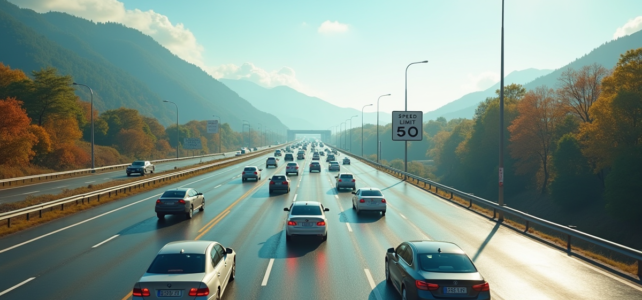
Faced with the constant increase in the number of vehicles on the roads, the issue of speed limits on highways is resurfacing. Some argue that reducing speed could decrease accidents and CO2 emissions, thus contributing to a safer and cleaner environment. Others, however, see it as an infringement on driving freedom and a hindrance to travel efficiency.
European governments, in particular, are increasingly tempted by this measure. In Germany, a country known for its unrestricted speed highways, serious discussions are underway. France has already implemented stricter limits on certain sections. The debate is far from over.
Arguments in favor of reducing speed on the highway
The reduction of speed on highways has many supporters among road safety experts and environmental advocates. The proposal from the Citizen’s Climate Convention to limit speed to 110 km/h on highways is supported by several personalities and organizations.
The International Energy Agency has presented the reduction of speed on highways as the primary lever to reduce oil consumption in advanced countries. According to Aurélien Bigo, a researcher on the energy transition in transportation, this measure would significantly reduce greenhouse gas emissions. Elisabeth Borne has also hinted that she is in favor of this reduction.
- Reduction of accidents: Road safety experts claim that reducing the maximum speed on highways significantly decreases the number and severity of accidents.
- Environmental impact: Reducing speed to 110 km/h would lower CO2 emissions, thus contributing to the fight against climate change.
- Fuel economy: A lower speed leads to reduced fuel consumption, which is beneficial for both drivers and the environment.
The proposal to limit speed to 110 km/h on highways has been positively received by the Citizen’s Climate Convention. Citizens see it as a necessary measure to achieve greenhouse gas emission reduction targets. The prospect of a 100 km/h highway in 2025, an April Fool’s joke for some, could become a reality with upcoming political decisions.
The arguments in favor of this measure are primarily focused on road safety and environmental protection. The question remains whether these reasons will be enough to convince policymakers and drivers. 
The challenges and controversies surrounding speed limits
The proposal to reduce speed to 110 km/h on highways is not universally accepted. Emmanuel Macron has already rejected this measure, highlighting the reluctance within the government. Pierre Chasseray, spokesperson for the association 40 million motorists, firmly opposes this limitation, arguing that it would penalize drivers without providing significant benefits in terms of road safety.
Objections from opponents
- Impact on traffic flow: Opponents fear that reducing speed will lead to additional traffic jams, especially during peak hours.
- Economic cost: Road transporters, represented by the Swiss Road Transport Association (ASTAG), believe that this measure would increase logistical costs and reduce the competitiveness of businesses.
- Social acceptance: The speed reduction could be poorly perceived by motorists, leading to an increase in violations and an overload of work for law enforcement.
In Switzerland, Transport Minister Simonetta Sommaruga has proposed an even more drastic reduction to 60 km/h on certain highway sections, an idea currently being studied by the Federal Roads Office (OFROU). This measure faces strong opposition from the Swiss Automobile Club (ACS) and ASTAG, who consider it counterproductive.
The challenges posed by speed limits are numerous and varied. Between economic issues, social acceptance, and real effectiveness, the question remains complex.