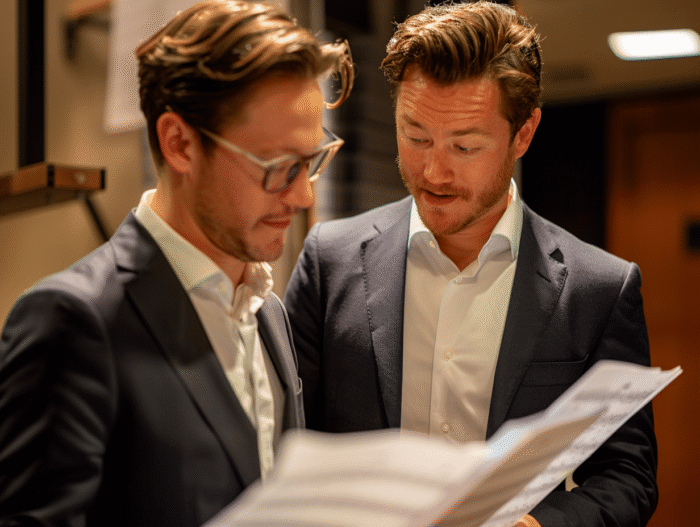
In the lyrical world, beyond the spotlights and the ovations, lie the often-unknown romances of contemporary great tenors. These artists, famous for their powerful voices and stage performances, live love stories worthy of the operas they perform. Their romantic lives, combining passion, drama, and sometimes discretion, fascinate as much as their talent. Between international tours and recordings, they weave bonds that are as intense as they are volatile, sometimes with partners sharing their artistic universe, sometimes far from the limelight. These relationships, sources of inspiration or torment, add a human dimension to their sublime art.
The Unknown Romances of Golden Voices
Behind the scenes of operas and theaters, away from the eyes of the world, contemporary tenors weave love stories often eclipsed by the brilliance of their voices. Richard, an emblematic figure of the lyrical century, shares his life with a soprano, also his partner on stage. Together, they embody those mythical opera couples that continue to fascinate. Their love life, parallel to their roles, is built on notes of harmony and discord, mirroring the productions in which they shine.
Philippe Jaroussky married, a renowned countertenor, offers another facet of these lyrical unions. His private life, kept away from the spotlight, reveals a man sharing his passion for music with his husband, far from the tumult of orchestras and the applause of the audience. Away from the stage, the musician lives a discreet yet profound love, which seems to be the quiet counterpoint to his bustling artistic existence.
Roberto Alagna, one of the greatest tenors of our time, currently finds himself in the spotlight not only for his masterful interpretations but also for his participation in a musical where he plays Al Capone. Alongside him, Anggun, playing the role of Rita, and Bruno Pelletier, as Eliot Ness, weave an intense story both on stage and in the city, where the boundaries between reality and fiction seem to blur.
The love lives of tenors thus form a complex mosaic where personal and professional histories intertwine. The partners of these artists, whether from the lyrical world or not, share a daily life rhythmically punctuated by rehearsals, travels, and performances. This existence, where love and art sometimes become one, gives these romances a particular hue, almost theatrical, where every gesture and every word can become the prelude to a new work.

When Lyrical Passion Meets Private Life
The lyrical stage, a space of magic and virtuosity, sees its protagonists live loves as intense as the operas they perform. Philippe Jaroussky and Jonas Kaufmann, each in their own way, illustrate this fusion between art and intimacy. While Jaroussky cultivates discretion, Kaufmann sometimes shares his private sphere, evoking the resonances between his roles on stage and his personal emotions. This permeability between life and art, this game of mirrors between the tenor and the man, creates a reality often more captivating than fiction itself.
The staging of the comic opera ‘Al Capone’ at the Folies Bergère offers a striking example of this intertwining. Roberto Alagna, Anggun, and Bruno Pelletier embody the iconic figures of an era marked by American prohibition. The Volstead Act and the United States of the 1920s are resurrected, for the duration of a performance, on the Parisian stage. The historical echoes of the show strangely find a reflection in the private lives of the artists, where the passion for their craft coexists with the reality of a daily life filled with challenges similar to those of their characters.
Jean-Félix Lalanne and Jean-Louis Grinda, respectively author and director, weave the fabric of this show where the destinies of Al Capone and Eliot Ness intersect and intertwine. The artists, through their creative work, explore not only a historical period but also the intricacies of human relationships that, like in their own lives, are often complex and tumultuous. Artistic creation, here, becomes an open window into the depths of the human soul.
The backstage of the opera then reveals these love stories, where artists, like soprano and tenor, mezzo-sopranos and conductors, share their lives in an incessant ballet between art and love. Catherine Siguret, in her book published by Albin Michel exploring the confessions of these artists, highlights how their personal experiences infuse into their performances. Adele Charvet, nurtured on the music of Cécilia Bartoli, and Louis Langrée, with his memories of being late to the opera, offer anecdotes that serve as windows into this world where opera and life often become one.